

Introduction
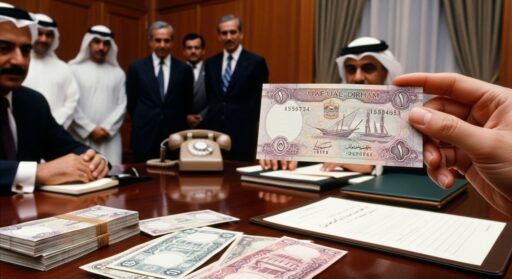
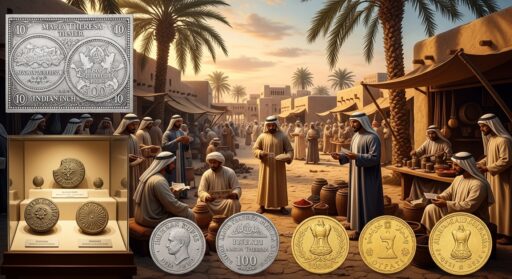
In the decades immediately preceding the launch of the UAE Dirham, the currency that filled the pockets of most residents in the Trucial States was not a local coin but a foreign note: the Gulf Rupee. Issued by the Government of India and effectively managed by the British, the Gulf Rupee was the dominant currency of the region from the 1950s until 1966. Its story is a fascinating chapter of colonial economic policy, one that intricately linked the economies of the Trucial Coast to the Indian subcontinent and whose sudden demise became a direct catalyst for the creation of a national currency.
History
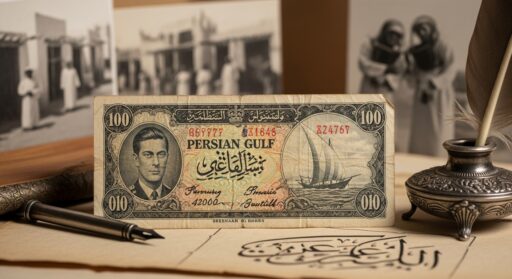
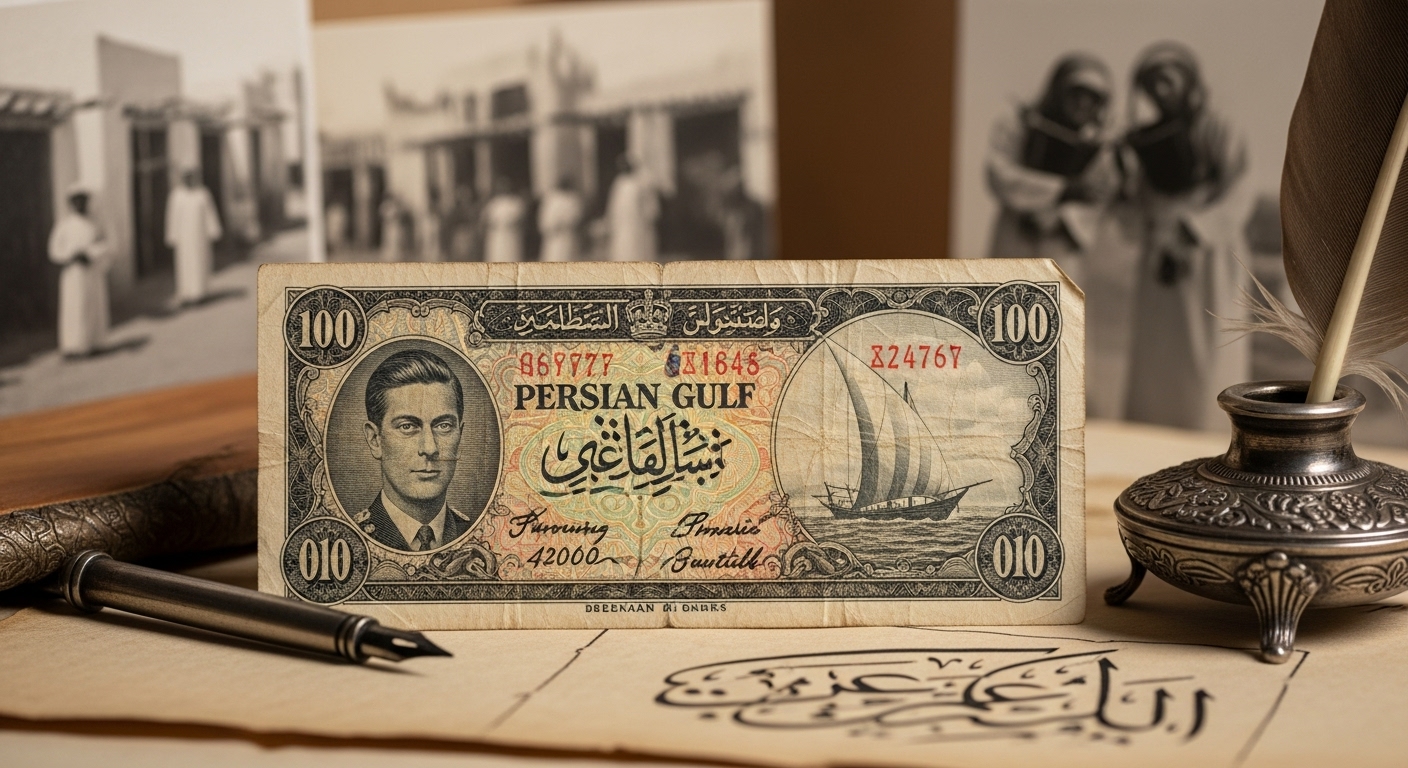
The Gulf Rupee was introduced as an extension of the Indian Rupee, which had circulated in the region for centuries due to robust trade links. However, following India’s independence in 1947, the British government became concerned about the mass smuggling of gold and silver into India, which was financed by the conversion of Indian rupees accumulated in the Gulf. To control this outflow and protect India’s foreign reserves, the British government, in consultation with the Government of India, created a separate currency in 1959: the Persian Gulf Rupee. It was issued by the Reserve Bank of India but was legal tender only in the Gulf states, including the Trucial States, Qatar, Bahrain, and Kuwait. It was pegged at par with the Indian Rupee but was not legal tender in India itself, creating a closed monetary circuit.
Key Features
The Gulf Rupee system was defined by its role as an instrument of colonial economic management:
- External Control: The currency was entirely controlled by external powers—the British government and the Reserve Bank of India. The rulers of the Trucial States had no say in its issuance, value, or monetary policy.
- Fixed Peg: The Gulf Rupee was pegged to the British Pound Sterling, which itself was pegged to a gold standard. This provided a degree of stability for regional trade.
- Restricted Convertibility: A key feature was its non-convertibility into Indian Rupees for residents of the Gulf, a rule designed specifically to prevent the currency from flowing back into India and destabilizing its economy.
- Physical Currency: The Gulf Rupee existed only as banknotes, with distinct designs and colours to distinguish them from regular Indian Rupees, though they held the same value.
Cultural Significance
The dominance of the Gulf Rupee was a clear symbol of the region’s political and economic status as a British protectorate. While practical for trade, it was a constant reminder that the Trucial States did not control their own financial destiny. The currency in people’s hands was a tangible link to the British imperial system and its priorities. For the local population, it was the currency of daily life, used to buy food, cloth, and other essentials, yet it bore the symbols and authority of a distant government, reinforcing a sense of indirect rule.
Modern Relevance
The Gulf Rupee’s importance lies in the dramatic nature of its demise. In 1966, India devalued its own rupee. Because the Gulf Rupee was pegged to it, it was also suddenly devalued by over 35%. This event caused immediate economic shock and significant financial losses for merchants and rulers in the Trucial States who held their wealth in Gulf Rupees. It was a stark and painful lesson in the perils of relying on a foreign currency subject to the political and economic whims of another nation. This crisis forced the rulers to act. Qatar and Dubai created the Qatar-Dubai Riyal to replace the Gulf Rupee, a direct and immediate response that served as a crucial precursor and prototype for the unified UAE Dirham a few years later. The Gulf Rupee’s failure was the catalyst that made a national currency an urgent necessity.
Conclusion
The story of the Gulf Rupee is a classic tale of colonial monetary engineering and its unintended consequences. It served British and Indian interests for a time, but its abrupt collapse exposed the fragility of an economic model built on dependency. The devaluation of 1966 was a financial shockwave that jolted the Trucial States into action, proving that true sovereignty was impossible without monetary sovereignty. The Gulf Rupee, therefore, occupies a critical place in UAE history not for its longevity, but for its failure. It was the currency whose collapse made the UAE Dirham inevitable, paving the way for a monetary system that was, for the first time, truly their own.